
Forschung & Projekte
Im Laufe ihrer Geschichte hat die limnologische Forschungsstation biogeochemische Kreisläufe in Süßwassersystemen untersucht, insbesondere in Fließgewässern und deren Verbindungen mit Grundwasser und Oberflächengewässern. Bei gleichzeitiger Beibehaltung dieser Perspektive liegt der Schwerpunkt unserer aktuellen Forschung auf der Rolle mikrobiologischer Gemeinschaften als Katalysatoren chemischer Reaktionen. Wir untersuchen mikrobielle Interaktionen und deren Einfluss auf biogeochemische Kreisläufe, mit dem Ziel, die Lücke zwischen mikroskaligen Prozessen und Funktionen auf Ökosystemebene zu schließen.
Laufende Projekte (auf English)
- Community composition and elemental fluxes in cultured microalgae-bacteria assemblages Einklappen
-
PI: Clara Martínez-Pérez
Funding: DOE Joint Genome Institute (JGI) 2024
This project investigates the relationship between microscopic ocean algae (phytoplankton) and their surrounding bacteria (phytoplankton microbiome) by sequencing and characterize the microbiome of cultured isolates of diatoms, an important phytoplankton group.
Diatoms, are responsible for ~40% of oceanic primary production– that is, around one fifth of all the photosynthesis on Earth, similar to all terrestrial rainforests combined [1]. While the influence of bacteria in diatom physiology and their impact on carbon cycling has been acknowledged [2], neither the composition (which types of bacteria and in which proportions) nor their potential (which functions can theses bacteria perform) are well understood.
This project addresses these unknowns by sequencing genomes of the bacteria co-isolated with and present in diatom cultures from the extensive NCMA collection. Our results aim to investigate host specificity and the dominant factors shaping algal-associated bacterial communities. These fundamental questions are not limited to marine systems and can be applied to microbial communities in other environments, such as freshwater systems, coastal sediments, and to communities surrounding plants’ roots.
Collaborating Partners:
Mike Lomas, Bigelow National Center for Algae and Microbiota (NCMA, USA)
- Microbial interactions in lake browningEinklappen
-
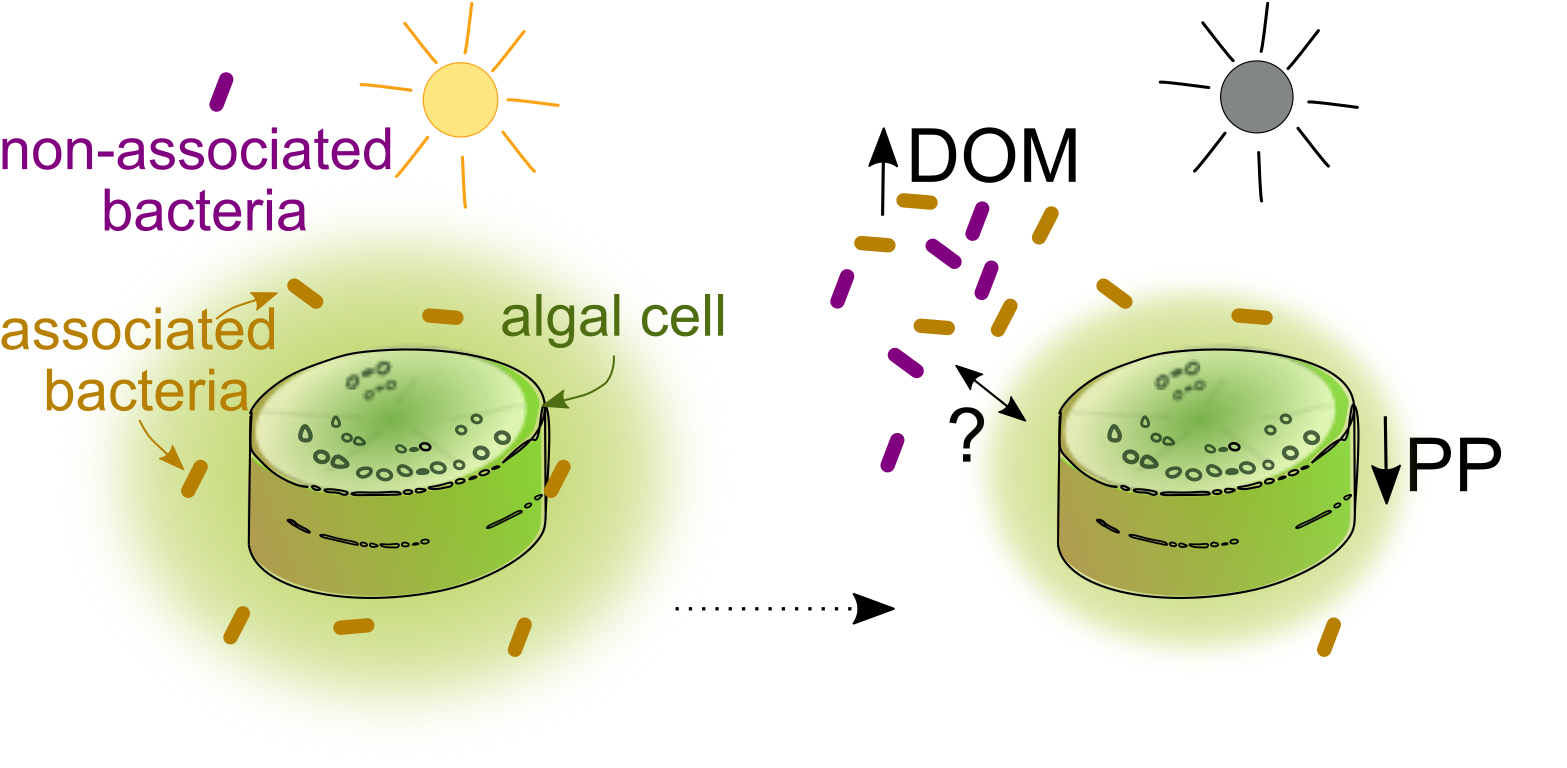
PI: Clara Martínez-Pérez, Co-Investigator: Alexander Frank (BayCenSI)
Funding: German Research Foundation (DFG) 2025
As climate change and human activities intensify, lakes are receiving increased inputs of dissolved organic matter (DOM), leading to water browning and reduced light availability. These changes pose challenges to aquatic ecosystems, affecting primary production, food webs, and the risk of toxic algal blooms. However, predicting the ecological consequences of lake browning remains difficult due to limited understanding of how microbial communities respond and adapt to these environmental shifts.
This project investigates how biotic interactions shape the response of phytoplankton (unicellular algae) and their associated bacteria under increased DOM and reduced light. We aim to assess how water browning influences phytoplankton physiology, the transfer of organic matter to bacteria, and shifts in bacterial community composition.
Collaborating Partners:
Marc Mußmann, Division of Microbial Ecology (DoME), University of Vienna (AT)